

What Is Obstructive Sleep Apnea And Why Does It Occur? | Physiology of OSA |
Signs & Symptoms | Diagnosis | Treatment
Overview
Obstructive sleep apnea is characterized by frequent awakening at night due to interruptions in breathing.
In other words, breathing pauses and re-starts repeatedly, preventing patients from having a restful and restorative night's sleep.[1][2]
What Is Obstructive Sleep Apnea?
Obstructive Sleep Apnea (OSA) is a common sleep disorder known to have serious implications on a patient's physical and mental health.
If not detected early and managed properly, it can increase the risk of several disorders, including heart attacks, hypertension, and depression.
It's crucial to be aware of what OSA is and why it occurs. Read on to know all about OSA, its symptoms, causes, risk factors, and the best methods to diagnose and treat it.
Physiology of OSA
OSA occurs when the muscles in the throat relax intermittently during sleep, leading to a blockage in the air passages.
Throat muscles are responsible for supporting structures such as the roof of the mouth (soft palate), the uvula (triangular tissue arising or hanging from the palate), the tongue, and the tonsils.
The excessive and repeated relaxation of throat muscles causes the tongue to fall back into the air passages, blocking airflow.
As a result, the oxygen levels in your blood drop while the carbon dioxide levels increase. These abnormal changes in the blood's parameters cause the brain to sense an impairment in breathing, rousing the patient from sleep.
Due to these physiological changes, patients with OSA often wake up gasping for breath. This awakening allows airways to reopen and breathing to resume.[3]
This breathing pattern can repeat itself 5 to 30 times (or more) every hour throughout the night.
Sleep disruptions can impair your ability to have a restful and restorative sleep, leaving you feeling unrefreshed, less alert, and tired the following day.
The common risk factors for OSA include:
- Gender: OSA is more prevalent in men than women
- Obesity: Excess fat around air passages can obstruct breathing
- Neck Size: More than 17" in men and more than 16" in women[4][5]
- Genetics
- Narrow airways due to enlarged tonsils or adenoids
- High blood pressure
- Unhealthy lifestyle habits, such as smoking[6]
OSA & Associated Conditions
There's a strong likelihood of comorbidity with the following conditions:
- Obesity
- Chronic nasal congestion due to sinusitis
- Diabetes
- Asthma
- Tonsilitis
- Hypertension

Snoring is a common sign of OSA and occurs as air passes through the obstructed air passages, creating turbulence.
People with obstructive sleep apnea may also experience other symptoms:[7][8]
- Episodic choking and gasping during sleep
- Daytime drowsiness
- Lack of clarity or reduced alertness in the morning
- Frequent headaches
- Feeling irritable and angry possibly due to the lack of sleep
- Forgetfulness
- Hyperactivity, especially in children
- Poor job and academic performance
- Swelling in the legs
- Loss of interest in sex
- Increased risk of vehicular accidents due to reduced alertness
Diagnosis
The most notable symptoms of OSA include frequent awakenings at night, daytime drowsiness, and snoring. The medical diagnosis must identify the cause of sleep apnea.
Further physical examination and tests can help to confirm the diagnosis.
During the physical check-up, the doctor will examine the mouth, back of the throat, nose for swelling, enlargement of tissues, or other abnormalities.
The doctor might measure the waist and neck circumference and check blood pressure to ascertain OSA's possible causes.
See below for the methods commonly used to confirm the diagnosis of OSA.
Apnea-Hypopnea index
The apnea-hypopnea index refers to the average number of times the obstructive events occur per hour.
In adults, the apnea-hypopnea index is usually greater than or equal to 15 per hour.
A diagnosis of moderate OSA is made when the apnea-hypopnea index is between 15 to 29.9 per hour. In severe cases of OSA, the apnea-hypopnea index is higher than 30 per hour.
In children, the apnea-hypopnea index of 5 to 9.9 is considered indicative of moderate OSA and 10 or greater per hour as considered to be indicative of severe OSA.[9][10]
Polysomnography
Polysomnography involves monitoring your breathing pattern, movements of your arms and legs, and blood oxygen levels during sleep.[11]
During this study, the patient is connected to the equipment, which monitors the heart, lungs, and brain's activities.
The doctor may recommend a full-night or a split-night polysomnography study.[12]
In full-night polysomnography, the patient is monitored throughout the night. In split-night polysomnography, the patient is monitored only during the first half of the night and given continuous positive airway pressure during the 2nd half of the night.
Home Sleep Apnea Testing
Your doctor may recommend an at-home polysomnography test to diagnose OSA.
This test assesses the breathing pattern, airflow, blood oxygen levels, snoring intensity, and limb movements.
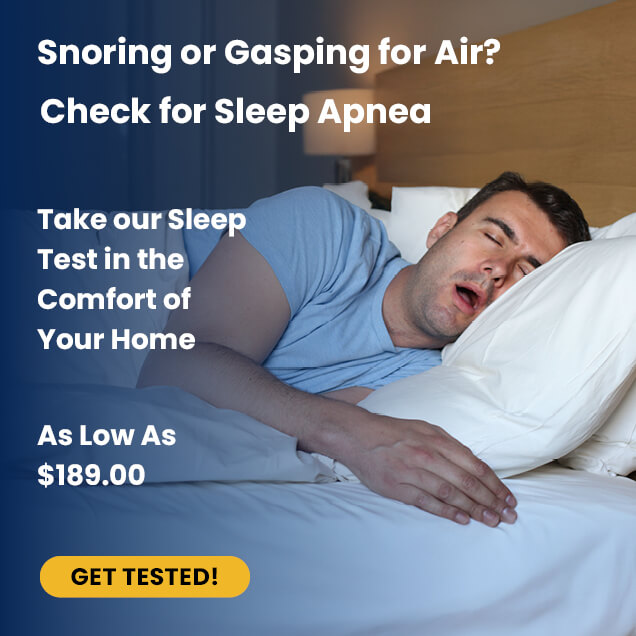
Home sleep testing is an affordable and convenient way to diagnose OSA. One such company that provides this medical service is MH Sleep Testing.
What are the complications of obstructive sleep apnea?
If not appropriately treated, obstructive sleep apnea may lead to complications, such as:
- Daytime drowsiness, irritability, and fatigue lead to difficulties in concentrating.
- Children and young adults may have poor academic performance and develop attention and behavioral problems.
- Depression and other mental health issues may occur due to the lack of sleep and its effect on daytime productivity and the overall quality of life.[13]
- A sudden drop in oxygen levels in the blood caused due to OSA might increase blood pressure and create more strain on the heart. This physiological reaction can increase your risk of hypertension, heart attacks, cardiac failure, and stroke.
- Patients with OSA are more likely to have arrhythmias (abnormal heart rhythms) as this condition can interfere with the heart's normal activities.
- OSA is linked to a higher instance of eye conditions, like glaucoma.
Treatment
OSA can be managed with the help of CPAP (continuous positive airway pressure) and oral devices, as explained below:
The CPAP machine consists of a mask that patients wear over the nose or mouth while sleeping.
The machine then pumps oxygen into the airways through the mask, thus improving oxygen flow. It allows the airways to remain open while sleeping and reduces the incidences of awakening.
Mandibular advancement devices, shaped like a mouth guard, can also be used to treat OSA. This device keeps the airways open while you are sleeping. Surgical treatments for managing severe cases of OSA include:
- Nasal procedures like septoplasty, nasal valve surgery, and rhinoplasty
- Upper pharyngeal procedures like uvulopalatopharyngoplasty, adenoidectomy, and tonsillectomy
- Lower pharyngeal procedures like hyoid and tongue suspension, mandibular advancement, and genioglossus advancement
- Tracheostomy
- Maxillomandibular advancement surgery
- Upper airway stimulation with the help of a device from Inspire. Patients only need to turn on the device with the click of a button to allow the airways to remain open.
The Takeaway
Being aware of OSA symptoms can allow patients to seek early medical intervention and prevent the complications of this disease. The advanced diagnostic methods can help diagnose OSA.
References:
- Slowik JM, Collen JF. Obstructive Sleep Apnea. [Updated 2020 Nov 20]. In: StatPearls [Internet]. Treasure Island (FL): StatPearls Publishing; 2020 Jan-. Available from: https://www.ncbi.nlm.nih.gov/books/NBK459252/
- Arnold, J., Sunilkumar, M., Krishna, V., Yoganand, S. P., Kumar, M. S., & Shanmugapriyan, D. (2017). Obstructive Sleep Apnea. Journal of pharmacy & bioallied sciences, 9(Suppl 1), S26–S28. https://doi.org/10.4103/jpbs.JPBS_155_17
- Pham, L. V., & Schwartz, A. R. (2015). The pathogenesis of obstructive sleep apnea. Journal of thoracic disease, 7(8), 1358–1372. https://doi.org/10.3978/j.issn.2072-1439.2015.07.28
- Millman, R. P., Carlisle, C. C., McGarvey, S. T., Eveloff, S. E., & Levinson, P. D. (1995). Body fat distribution and sleep apnea severity in women. Chest, 107(2), 362–366. https://doi.org/10.1378/chest.107.2.362
- Davies, R. J., & Stradling, J. R. (1990). The relationship between neck circumference, radiographic pharyngeal anatomy, and the obstructive sleep apnoea syndrome. The European respiratory journal, 3(5), 509–514.
- Krishnan, V., Dixon-Williams, S., & Thornton, J. D. (2014). Where there is smoke…there is sleep apnea: exploring the relationship between smoking and sleep apnea. Chest, 146(6), 1673–1680. https://doi.org/10.1378/chest.14-0772
- Hoffstein, V., & Szalai, J. P. (1993). Predictive value of clinical features in diagnosing obstructive sleep apnea. Sleep, 16(2), 118–122.
- Mulgrew, A. T., Ryan, C. F., Fleetham, J. A., Cheema, R., Fox, N., Koehoorn, M., Fitzgerald, J. M., Marra, C., & Ayas, N. T. (2007). The impact of obstructive sleep apnea and daytime sleepiness on work limitation. Sleep medicine, 9(1), 42–53. https://doi.org/10.1016/j.sleep.2007.01.009
- Hoffstein, V., & Szalai, J. P. (1993). Predictive value of clinical features in diagnosing obstructive sleep apnea. Sleep, 16(2), 118–122.
- Millman, R. P., Carlisle, C. C., McGarvey, S. T., Eveloff, S. E., & Levinson, P. D. (1995). Body fat distribution and sleep apnea severity in women. Chest, 107(2), 362–366. https://doi.org/10.1378/chest.107.2.362
- Medical Advisory Secretariat (2006). Polysomnography in patients with obstructive sleep apnea: an evidence-based analysis. Ontario health technology assessment series, 6(13), 1–38.
- Nixon, G. M., & Brouillette, R. T. (2002). Diagnostic techniques for obstructive sleep apnoea: is polysomnography necessary?. Paediatric respiratory reviews, 3(1), 18–24. https://doi.org/10.1053/prrv.2002.0176
- Jehan, S., Auguste, E., Pandi-Perumal, S. R., Kalinowski, J., Myers, A. K., Zizi, F., Rajanna, M. G., Jean-Louis, G., & McFarlane, S. I. (2017). Depression, Obstructive Sleep Apnea and Psychosocial Health. Sleep medicine and disorders : international journal, 1(3), 00012.