
Use the player to listen to the article and/or continue to read below.
Epidemiology | Pathophysiology | Symptoms | Differential Diagnosis | Management | Medications | Cognitive Behavior Therapy
Overview
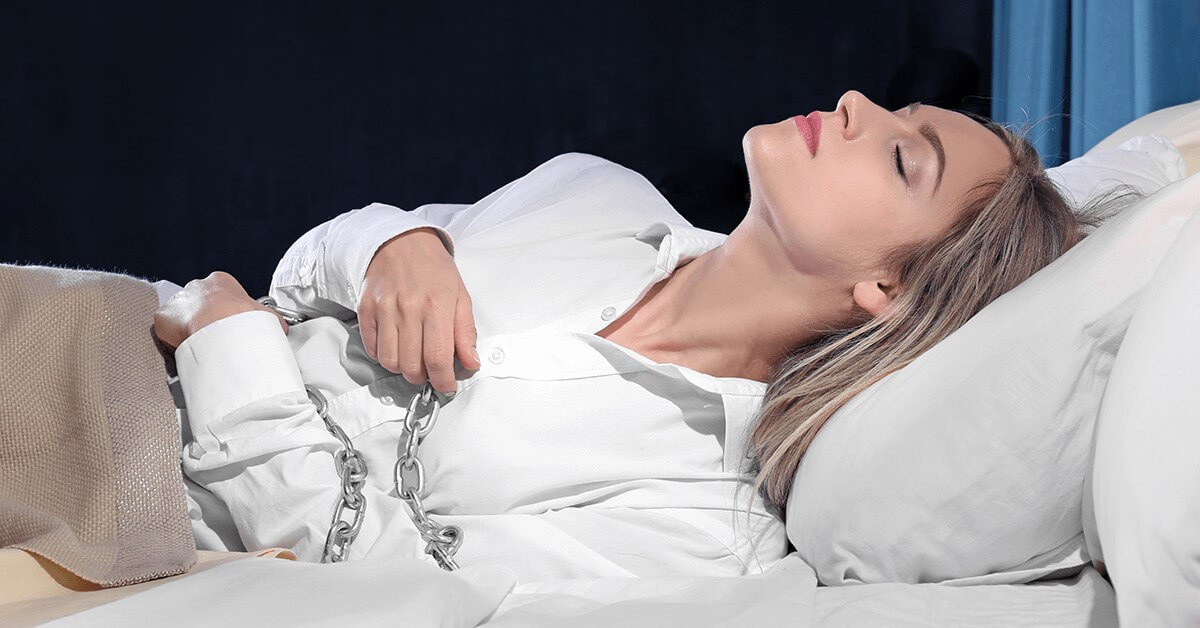
Sleep Paralysis (SP) is characterized by temporary atonia, or muscle loss, while falling asleep or waking up from sleep.
It happens when the muscle weakness and paralysis that are normal parts of REM sleep intrude into wakefulness.
During an SP episode, consciousness remains intact, and you have full awareness of your surroundings.
If you’re unfamiliar with this phenomenon, a terrifying feeling can arise from the sudden but short-lived inability to move your body while being fully awake.
SP is also characterized by hallucinations, such as sensing the presence of others nearby, feeling pressure on the throat, or suffocation.[1]
Recurrent SP is often associated with narcolepsy. If it is not associated with narcolepsy, it is known as isolated sleep paralysis (ISP).
Approximately 20 percent of young adults with anxiety disorder can experience isolated SP.[2] Sleep deprivation in otherwise healthy teenagers is also a common trigger.
A differential diagnosis includes partial seizures, periodic paralysis, and narcolepsy.
Occasional SP is generally due to sleep deprivation and does not need treatment. Direct treatments have not been evaluated for recurrent episodes.
For patients with an underlying anxiety disorder, the treatment for the anxiety may alleviate the ISP.
In some cases, treatment with REM-suppressing agents, such as low doses of tricyclic agents, clonidine, or clonazepam, have shown some effectiveness.
Epidemiology
SP is common within the general population, showing a higher prevalence amongst students and people with underlying psychiatric conditions.
A review of 35 studies on the prevalence of SP found that 8 percent of the general population experienced this condition. [3]
Twenty-eight percent of students and 32 percent of psychiatric patients experienced at least one episode of SP within the general population. [3]
Of the psychiatric patients with panic disorder, 35 percent reported lifetime SP. Results also suggested that racial minorities experience lifetime SP at higher rates than Caucasians.[3]

Pathophysiology
The results of studies on pathophysiology are not entirely conclusive, although there are several theories regarding its causes.
- Disturbance of regular sleeping patterns, such as shift work or jet lag, can cause an episode of SP.
- Neural functions that regulate sleep may be out of balance to cause different sleep states to overlap momentarily.
- Studies on identical twins have shown a genetic component in sleep paralysis. [4] When one twin experiences SP, there is a high likelihood of the other twin experiencing it as well. Further studies are needed to determine whether other factors such as arousal signaling, melatonin regulation or disruption of neural populations are involved.
- Personality Factors: higher levels of imaginativeness and belief in supernatural/paranormal may predispose a person to SP.
Symptoms
- Paralysis of the body when falling asleep or upon waking, lasting for seconds up to several minutes
- Being unable to speak during the episode
- Having hallucinations and sensations that cause fear
- Feeling pressure on the chest
- Having difficulty breathing
- Feeling a sense of doom
- Sweating
- Having headaches, muscle pains, and paranoia
- Numbness throughout the body, feelings of being dragged or flying, and feelings of electric tingles or vibrations running through the body[5]
Differential Diagnosis
Several sleep-related conditions share characteristics with sleep paralysis. Please consult with your health care provider to determine a proper diagnosis.
- Exploding Head Syndrome (EHS) is a potentially frightening parasomnia; however, episodic hallucinations are momentary, characterized by a loud or jarring sound, and can include muscle jerks and twitches.[6]
- Nightmare Disorder (ND) occurs during REM sleep and is characterized by chronic unsettling dreams/nightmares, which do not include paralysis as a symptom.
- Sleep Terrors (STs) typically occur during the transition from Non-REM to REM sleep phases. The main difference between this condition and SP is a lack of awareness of surroundings. Vocalizations often occur during STs.[6]
- Nocturnal Panic Attacks (NPAs) involve fear and acute distress but lacks paralysis and the dream imagery that accompanies SP.[6]
- Post-Traumatic Stress Disorder (PTSD) is characterized by nightmares that occur during NREM and REM sleep phases.[7]
- Schizophrenia/Psychotic Disorders and sleep paralysis often share disturbing and unwanted hallucinations. The critical difference is that the experiences in sleep paralysis are limited to sleep-wake transitions.
Management
Management of the condition starts with education about sleep stages and the physiology surrounding the inability to move muscles during REM sleep.
An evaluation for narcolepsy should be completed if the symptoms persist. The safest treatment for sleep paralysis is for people to adopt healthier sleeping habits, but medications or therapy may be prescribed in more severe cases.
Medications
The most commonly used medications are tricyclic antidepressants and selective serotonin reuptake inhibitors. The intended action from both is the suppression of REM sleep.
There is currently no medication available to completely suppress episodes of sleep paralysis, although several drugs have shown promise in case studies. Two trials of GHB for people with narcolepsy demonstrated reductions in sleep paralysis episodes.[8]
Pimavanserin, an antipsychotic, has been proposed as a possible candidate for future studies in treating sleep paralysis.[9]
Cognitive Behavior Therapy
Cognitive behavior therapy for isolated sleep paralysis (CBT-ISP) begins with self-monitoring of symptoms, restructuring of negative thoughts relevant to ISP, and education about the nature of sleep paralysis.
Prevention techniques include ISP-specific sleep hygiene and the use of various relaxation techniques, like deep breathing, mindfulness, progressive muscle relaxation, and meditation.
Episodic disruption techniques are first practiced in session and then applied during actual attacks. No controlled trial of CBT-ISP has yet been conducted to prove its effectiveness.
Conclusion
Isolated sleep paralysis can be an unsettling experience that can be recurrent under certain circumstances.
Although there are some options available for assessment and treatment at this time, more research is needed to establish a gold standard for assessment and better empirically supported treatment recommendations.
References:
- Farooq, M., & Anjum, F. (2020). Sleep Paralysis. In StatPearls. StatPearls Publishing.
- Otto, M. W., Simon, N. M., Powers, M., Hinton, D., Zalta, A. K., & Pollack, M. H. (2006). Rates of isolated sleep paralysis in outpatients with anxiety disorders. Journal of anxiety disorders, 20(5), 687–693. https://doi.org/10.1016/j.janxdis.2005.07.002
- Sharpless, B. A., & Barber, J. P. (2011). Lifetime prevalence rates of sleep paralysis: a systematic review. Sleep medicine reviews, 15(5), 311–315. https://doi.org/10.1016/j.smrv.2011.01.007
- Sehgal, A., & Mignot, E. (2011). Genetics of sleep and sleep disorders. Cell, 146(2), 194–207. https://doi.org/10.1016/j.cell.2011.07.004
- Cheyne, J. A., Rueffer, S. D., & Newby-Clark, I. R. (1999). Hypnagogic and hypnopompic hallucinations during sleep paralysis: neurological and cultural construction of the night-mare. Consciousness and cognition, 8(3), 319–337. https://doi.org/10.1006/ccog.1999.0404
- Sharpless, Brian A.; Doghramji, Karl (2015). Sleep Paralysis: Historical, Psychological, and Medical Perspectives. Oxford University Press. pp. 170–181. ISBN 9780199313808 https://oxfordmedicine.com/view/10.1093/med/9780199313808.001.0001/med-9780199313808
- van der Kolk, B., Blitz, R., Burr, W., Sherry, S., & Hartmann, E. (1984). Nightmares and trauma: a comparison of nightmares after combat with lifelong nightmares in veterans. The American journal of psychiatry, 141(2), 187–190. https://doi.org/10.1176/ajp.141.2.187
- Sharpless B. A. (2016). A clinician’s guide to recurrent isolated sleep paralysis. Neuropsychiatric disease and treatment, 12, 1761–1767. https://doi.org/10.2147/NDT.S100307
- Jalal B. (2018). The neuropharmacology of sleep paralysis hallucinations: serotonin 2A activation and a novel therapeutic drug. Psychopharmacology, 235(11), 3083–3091. https://doi.org/10.1007/s00213-018-5042-1