
Use the player to listen to the article and/or continue to read below.
Social Media & Sleep | How Sleep is Affected
Overview
A day will come when the timelines are divided into BSM and ASM: before social media and after social media. Thanks to technology, there’s probably a huge difference in how you spend your time now compared to 20 years ago.
What you may not know is that the time you spend on social media may affect your sleep quality, making you prone to insomnia and related diseases.
Read on to learn more about the link between the time you spend on social media, especially before bedtime, and the quality of your sleep.
Social Media & Sleep
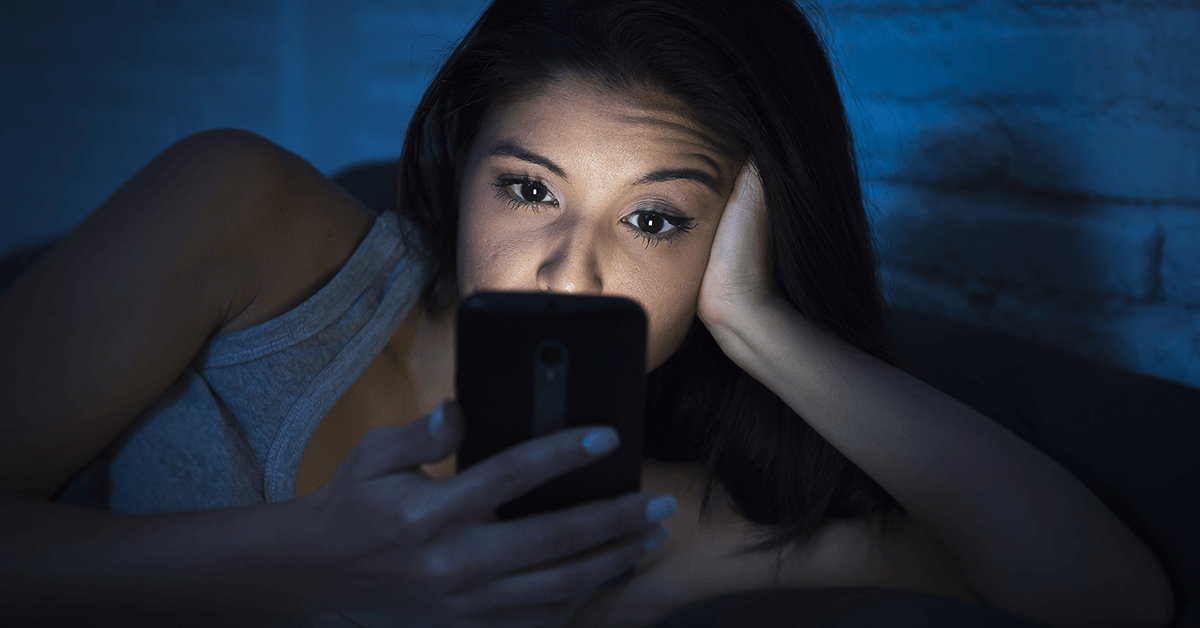
Many of us retire for the night with our cell phones in hand, checking the latest status updates of friends or watching the hottest TikTok dance.
Scrolling through your Facebook, Instagram, and Twitter has become a habit before going to bed, possibly because we hardly get any time during the day for these activities. However, this seemingly relaxing time you spend on social media can create trouble for you by affecting your sleep.
Studies show a correlation between social media use before bed and poor sleep among young adults ages 19 to 32.[1]
Let’s check why the time you spend on social media could be directly proportional to your chances of you developing sleep problems.

How does your Time on Social Media Affect your Sleep?
1. Reduces Melatonin Production
Research studies show that watching digital devices can reduce the secretion of a sleep hormone called melatonin.
The blue light emitted by these devices enters through your eyes and travels to your brain, which tricks your brain into believing it’s still daytime, causing it to shut down melatonin secretion.[2][3] Without adequate melatonin, falling asleep can become more difficult for you.
Sleep experts state that you should avoid using smartphones and laptops for at least 4 hours before bed. This allows your brain to produce an adequate amount of melatonin for sleep.
2. Cognitive Arousal
Checking your smartphone to know who is doing what is exactly the opposite of what you should be doing at bedtime.
Spending time on social media after dinner can get you wound up instead of winding you down, preparing your mind for sleep. This scrolling through social media posts stimulates your brain, triggering cognitive arousal in your nervous system.[4] [5]It sends signals to your brain and body to stay active and keeps you engaged.
The processes that lead to sleep, like your muscles relaxing, can fail, thereby preventing you from falling asleep.[6]
3. Emotional Stress
Checking out social media posts can trigger emotional stress, both positive and negative. Viewing a sad video may increase your mental stress and anxiety.
At the same time, messages discussing an upcoming event or the planning of your friend’s birthday party may cause emotional excitement, thus engaging your brain with joyful thoughts.
Positive or negative posts on social media can contribute to emotional stress and prevent you from falling asleep.[7]
4. Delayed Bedtime
The time you spend surfing is the time you should have spent sleeping.
The tricky part is that we believe that it takes just a few minutes to check our social media accounts before going to sleep.
But, once you grab your phone, you find yourself falling down a rabbit hole of funny comments, chatting with friends, photos, entertaining videos, and reading newsfeeds. Before you realize it, an hour or two has passed!
This habitual nighttime browsing can displace your bedtime by a few hours and increase your sleep onset period, making you lose precious sleep time.[8]
5. FOMO
FOMO (Fear Of Missing Out) and social disapproval are the major forces driving social media use, especially for teenagers.[9]
If you’re not connected, you’re missing out! That’s what we have come to believe. The uneasiness associated with missing out can keep you awake for hours after you’ve laid down to go to sleep.[10]
6. Notifications and Alerts
It’s hard to ignore the notifications on your phone. You may feel compelled to check the messages and even reply to them in the middle of the night.
These notifications from your social media accounts can keep you from sleeping well by waking you up constantly throughout the night.[11] You may be tempted to check your messages and alerts, causing your sleep to be disrupted.
Consider these notifications as ‘red alerts,’ warning you about the impending health issues linked to sleeplessness and shut them off. Turning off notifications before bedtime will help you enjoy an undisturbed sleep without any beeps.
Conclusion
It’s good to catch up with your friends and loved ones on social media, but you must limit the time you spend on Facebook, Instagram, WhatsApp, and other sites, especially before bedtime.
There are just too many ways social media can affect your sleep. It may prevent you from falling asleep, cause frequent awakenings, increase your sleep onset period, and much more.
Remember that social media is for entertainment and to help us connect with friends and family. Don’t let it come in the way of your sleep and health in general.
A good rule of thumb is to avoid social media interactions on your digital device for at least 4 hours before bedtime, not to impact the quality and duration of your sleep.
If you continue to have difficulty sleeping, make a point of speaking to your doctor. There are programs online that you can use to get your sleep back on track without the use of supplements or sleeping pills.
These programs use Cognitive Behavioral Therapy for Insomnia (CBT-i) to help you overcome insomnia by adjusting your thought processes and behavior.
References:
- Levenson, J. C., Shensa, A., Sidani, J. E., Colditz, J. B., & Primack, B. A. (2016). The association between social media use and sleep disturbance among young adults. Preventive medicine, 85, 36-41. https://www.sciencedirect.com/science/article/abs/pii/S0091743516000025
- Hale, L., Kirschen, G. W., LeBourgeois, M. K., Gradisar, M., Garrison, M. M., Montgomery-Downs, H., Kirschen, H., McHale, S. M., Chang, A. M., & Buxton, O. M. (2018). Youth Screen Media Habits and Sleep: Sleep-Friendly Screen Behavior Recommendations for Clinicians, Educators, and Parents. Child and adolescent psychiatric clinics of North America, 27(2), 229–245. https://doi.org/10.1016/j.chc.2017.11.014.
- Tosini, G., Ferguson, I., & Tsubota, K. (2016). Effects of blue light on the circadian system and eye physiology. Molecular vision, 22, 61–72.
- Garett, R., Liu, S., & Young, S. D. (2018). The Relationship Between Social Media Use and Sleep Quality among Undergraduate Students. Information, communication and society, 21(2), 163–173. https://doi.org/10.1080/1369118X.2016.1266374.
- Fobian, A. D., Avis, K., & Schwebel, D. C. (2016). Impact of Media Use on Adolescent Sleep Efficiency. Journal of developmental and behavioral pediatrics : JDBP, 37(1), 9–14. https://doi.org/10.1097/DBP.0000000000000239.
- Walker, M. P., & van der Helm, E. (2009). Overnight therapy? The role of sleep in emotional brain processing. Psychological bulletin, 135(5), 731–748. https://doi.org/10.1037/a0016570.
- Winneke A. van der Schuur, Susanne E. & Baumgartner &Sindy R. Sumter. (2018). Social Media Use, Social Media Stress, and Sleep: Examining Cross-Sectional and Longitudinal Relationships in Adolescents. Health Communications. https://doi.org/10.1080/10410236.2017.1422101.
- Fobian, A. D., Avis, K., & Schwebel, D. C. (2016). Impact of Media Use on Adolescent Sleep Efficiency. Journal of developmental and behavioral pediatrics : JDBP, 37(1), 9–14. https://doi.org/10.1097/DBP.0000000000000239.
- Adams, S. K., Murdock, K. K., Daly-Cano, M., & Rose, M. (2020). Sleep in the Social World of College Students: Bridging Interpersonal Stress and Fear of Missing Out with Mental Health. Behavioral sciences (Basel, Switzerland), 10(2), 54. https://doi.org/10.3390/bs10020054.
- Scott, H., & Woods, H. C. (2018). Fear of missing out and sleep: Cognitive behavioural factors in adolescents’ nighttime social media use. Journal of adolescence, 68, 61–65. https://doi.org/10.1016/j.adolescence.2018.07.009.
- Alshobaili, F. A., & AlYousefi, N. A. (2019). The effect of smartphone usage at bedtime on sleep quality among Saudi non- medical staff at King Saud University Medical City. Journal of family medicine and primary care, 8(6), 1953–1957. https://doi.org/10.4103/jfmpc.jfmpc_269_19.